
Understanding UL 94 Flammability Ratings and Industry Compliance
Decoding the UL 94 Standard: V-0, V-1, V-2, and HB
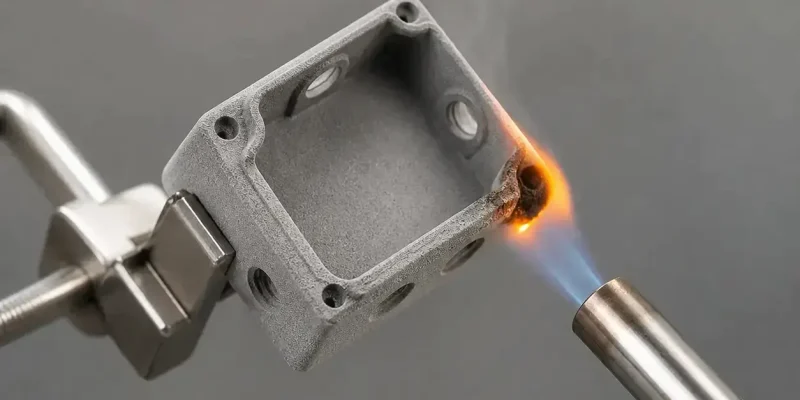
The UL 94 standard evaluates how plastic materials extinguish flames after ignition. Vertical ratings (V-0, V-1, V-2) are stricter than the horizontal HB rating.
Key performance metrics determine the final classification for each material sample. Engineers must monitor after-flame time, dripping behavior, and cotton ignition.
| Rating | Max After-Flame Time (per specimen) | Dripping Particles Ignite Cotton? |
|---|---|---|
| V-0 | ≤ 10 seconds | No |
| V-1 | ≤ 30 seconds | No |
| V-2 | ≤ 30 seconds | Yes |
| HB | Burns slowly or self-extinguishes | N/A |
V-0 is the preferred choice for high-risk applications due to its rapid self-extinguishing properties. V-2 allows flaming drips, which limits its use in sensitive electronics.

Impact on Material Selection in Regulated Industries
Electronics manufacturers prioritize V-0 rated plastics for enclosures and connectors. This rating minimizes fire propagation risks in densely packed PCB assemblies.
Aerospace industries use UL 94 as a baseline but enforce stricter FAR 25.853 standards. Materials must pass vertical burn tests with specific heat release limits.
Automotive engineers integrate UL 94 data with FMVSS 302 requirements for interiors. Under-the-hood components often require higher thermal stability alongside flamm resistance.
- Consumer Electronics: V-0 ensures safety near high-voltage components.
- Aviation: Combines UL data with smoke density and toxicity tests.
- Automotive: Balances flame retardancy with mechanical durability under heat.
Navigating Certification and Documentation
Always verify material claims using the UL Online Certifications Directory (Yellow Card). Supplier datasheets may list target ratings rather than certified values.
Distinguish between Recognized Component status and end-product certification. A plastic resin may be UL recognized, but the final device needs separate evaluation.
Global compliance requires checking IEC 60695 standards alongside UL 94. Differences in test protocols can affect approval in European or Asian markets.
- Verify: Cross-reference grade names with the UL Yellow Card database.
- Differentiate: Resin certification does not equal final product approval.
- Globalize: Align UL tests with IEC equivalents for international sales.
Sourcing Fire-Retardant Plastic Sheetings for Construction and Containment
Meeting Safety Standards: NFPA 701 and ASTM E-84
NFPA 701 is the standard method for fire tests for flame propagation of textiles and films. It specifically applies to temporary structures like tarps and containment barriers.
Passing this test ensures the material self-extinguishes quickly after the ignition source is removed. This prevents rapid fire spread in dynamic construction environments.
ASTM E-84 measures surface burning characteristics using the Steiner Tunnel Test. It generates two critical metrics for building code compliance.
- Flame Spread Index (FSI): Must typically remain below 25 for Class A rating.
- Smoke Developed Index (SDI): Must generally stay under 450 to maintain visibility during evacuation.
Local jurisdictions often enforce stricter rules than national standards. Always consult the local fire marshal before purchasing bulk materials.
Regional codes may require specific certification labels attached to every roll. Failure to comply can result in work stoppages and heavy fines.


Applications in Construction and Industrial Containment
Dust barriers require secure installation to maintain both containment and fire safety. Use fire-retardant polyethylene sheeting with a minimum thickness of 6 mil.
Seal all seams with approved fire-rated tape to prevent air leakage. Ensure zippers and access points also meet flame resistance standards.
Welding curtains face direct exposure to sparks and molten metal splash. Standard polyethylene melts instantly under these conditions.
Select heavy-duty FR vinyls rated for high heat exposure. These materials char rather than melt, maintaining barrier integrity during hot work.
Negative air pressure systems demand airtight containment for hazardous abatement. Any breach compromises both safety and regulatory compliance.
Inspect sheeting regularly for tears caused by equipment movement. Replace damaged sections immediately to preserve fire retardant properties and containment pressure.
Purchasing Guide: Features to Look For
Thickness directly impacts durability and tear resistance during installation. Industry standard measurements use mils (1 mil = 0.001 inch).
- 4-6 mil: Suitable for light dust containment and short-term use.
- 10-12 mil: Required for heavy-duty containment and longer project durations.
Thicker gauges offer better puncture resistance but do not inherently improve fire ratings. Verify the fire retardant additive is consistent throughout the material layer.
UV stabilization is critical for outdoor temporary structures exposed to sunlight. Unstabilized plastics degrade and lose tensile strength within weeks.
Look for materials with added UV inhibitors for projects lasting over 30 days. Degraded plastic becomes brittle and fails fire tests prematurely.
Always request current test reports from suppliers before finalizing bulk orders. Certifications should be less than 12 months old to ensure validity.
- Check for independent lab verification (e.g., UL or Intertek).
- Confirm the report matches the exact product SKU being purchased.
Verify that physical certification labels are present on each roll. Missing labels can lead to rejection by site safety inspectors.
Comparing Chemical Classes of Flame Retardant Additives
Halogenated Flame Retardants: Performance vs. Regulation
Brominated and chlorinated flame retardants function primarily through radical scavenging in the gas phase. They interrupt the combustion chain reaction by capturing high-energy free radicals.
- Efficiency: These additives achieve UL94 V-0 ratings at low loading levels, typically 5–15 wt%.
- Mechanical Impact: Low loadings help preserve the tensile strength and impact resistance of the base polymer.
Regulatory pressure is driving a significant shift away from specific halogenated compounds. Standards like RoHS and REACH restrict substances such as Deca-BDE due to persistence and toxicity concerns.
| Constraint | Detail |
|---|---|
| Restricted Substances | Polybrominated diphenyl ethers (PBDEs) |
| Key Regulation | EU RoHS Directive, REACH SVHC List |
| Industry Trend | Phase-out in consumer electronics and automotive sectors |
Phosphorus-Based Flame Retardants: The Growing Alternative
Phosphorus-based additives operate through dual mechanisms depending on their chemical structure. They promote char formation in the condensed phase to create a protective barrier.
- Gas Phase Action: Some volatile phosphorus species trap radicals similar to halogens but with less toxicity.
- Condensed Phase Action: Phosphoric acid derivatives catalyze dehydration, forming a stable carbonaceous char layer.
These additives are increasingly preferred in engineering plastics like polycarbonate and nylon. They offer lower smoke generation compared to halogenated options and meet strict halogen-free specifications.
| Type | Example | Primary Mechanism |
|---|---|---|
| Organic Phosphates | Resorcinol bis(diphenyl phosphate) | Char formation + Gas phase |
| Phosphonates | DOPO derivatives | Radical trapping |
| Inorganic | Red Phosphorus | Char promotion |
Metal Hydroxides and Inorganic Fillers
Aluminum Trihydrate (ATH) and Magnesium Hydroxide (MDH) rely on endothermic decomposition for flame retardancy. They absorb heat energy and release water vapor, which dilutes combustible gases.
- ATH Decomposition: Occurs around 200°C, making it suitable for polymers with lower processing temperatures.
- MDH Decomposition: Occurs around 300–330°C, allowing use in higher-temperature engineering plastics.
These fillers are non-toxic, non-corrosive, and cost-effective. However, they require high loading levels, often exceeding 50–60 wt%, to achieve meaningful flame retardancy.
| Trade-off | Impact on Formulation |
|---|---|
| Viscosity | Significant increase, requiring lubricants or processing aids |
| Mechanical Strength | Reduced tensile and impact properties due to high filler content |
| Density | Increased part weight, affecting automotive fuel efficiency metrics |
Selecting the Right Additive for Your Polymer Formulation
Choosing the correct flame retardant depends heavily on polymer compatibility and the intended application environment. Polyolefins often pair well with halogenated or mineral fillers, while engineering thermoplastics favor phosphorus-nitrogen systems.
- Polyolefins (PP/PE): Use ATH/MDH for low cost or brominated FRs for high performance.
- Engineering Plastics (PC/ABS/PBT): Prefer phosphorus-based FRs to maintain mechanical integrity.
- Elastomers: Often require intumescent systems or specialized halogen-free blends.
Synergistic systems can enhance performance while reducing total additive load. For example, combining nitrogen and phosphorus creates an intumescent char that provides superior insulation.

| Processing Factor | Consideration |
|---|---|
| Thermal Stability | Ensure additive decomposition temperature exceeds processing temp (e.g., >280°C for PC) |
| Shear Sensitivity | High filler loads may cause excessive shear heating during extrusion |
| Corrosion Risk | Avoid halogenated FRs in sensitive electronic assemblies without proper encapsulation |
Health Risks and Toxicity in Recycled Black Plastics
The Hidden Danger: Brominated Flame Retardants in Recyclates
Legacy flame retardants from Waste Electrical and Electronic Equipment (WEEE) frequently contaminate general plastic recycling streams. This occurs when e-waste is improperly segregated or mechanically shredded alongside consumer packaging.
Black plastics present a unique sorting challenge because carbon black pigments absorb near-infrared (NIR) light. Standard NIR sensors cannot detect the polymer type, allowing hazardous materials to bypass automated separation systems.
| Contaminant | Typical Source | Common Recycled Application |
|---|---|---|
| PBDEs | Old TV casings, circuit boards | Automotive dashboards, park benches |
| HBCDD | Polystyrene insulation foam | Food trays (historically), crate liners |
Studies show significant levels of Polybrominated Diphenyl Ethers (PBDEs) in recycled household goods. Hexabromocyclododecane (HBCDD) also persists in recycled polystyrene used for automotive parts and construction materials.

Health Implications of Toxic Exposure
Brominated flame retardants (BFRs) act as endocrine disruptors by mimicking thyroid hormones. This interference can lead to metabolic disorders and reproductive health issues in adults.
Children are particularly vulnerable to neurodevelopmental risks from early-life exposure. Elevated BFR levels correlate with reduced IQ scores and increased behavioral problems such as ADHD.
- Bioaccumulation: These chemicals store in fatty tissues and do not break down easily.
- Persistence: They remain in the environment for decades, cycling through food chains.
Long-term exposure classifies many BFRs as Persistent Organic Pollutants (POPs). Regulatory bodies link these compounds to increased carcinogenic potential in animal studies.
Safety in Food Packaging and Household Goods
Regulatory agencies strictly ban recycled black plastics in food contact applications. The EU Commission Regulation (EU) No 10/2011 and FDA guidelines prohibit materials with unknown chemical histories.
High-risk products often include items where color masks material origin. Consumers should exercise caution with:
- Kitchen utensils (spatulas, cutting boards)
- Toy components made from mixed recyclates
- Casings for small consumer electronics
Identifying contaminated items is difficult due to the lack of labeling. Consumers should avoid using scratched or degraded black plastic containers for hot foods.
Proper disposal involves separating e-waste from general plastic recycling. This prevents legacy toxins from re-entering the circular economy for consumer goods.
Industry Moves Toward Safer Recycling Practices
Advanced sorting technologies now use X-ray fluorescence (XRF) to detect bromine content directly. This allows facilities to identify and remove hazardous black plastics that NIR sensors miss.
Chemical recycling offers a solution by breaking polymers into monomers. This process separates flame retardants from the plastic feedstock before repolymerization.
| Technology | Mechanism | Benefit |
|---|---|---|
| XRF Sorting | Detects elemental bromine | Identifies BFR-contaminated fragments |
| Pyrolysis | Thermal decomposition | Separates organic additives from oil/gas |
Design for Recycling (DfR) initiatives encourage manufacturers to use non-halogenated flame retardants. Phosphorus-based or nitrogen-based alternatives do not interfere with future recycling processes.
Adopting these safer additives protects the quality of future recyclates. It ensures that closed-loop systems remain free from persistent toxic contaminants.
Suppliers and Applications of High-Performance Flame-Retardant Engineering Plastics
Top-Tier Materials: PEEK, PAI, and PPS Overview
PEEK offers inherent flame resistance without heavy halogenated additives. It maintains structural integrity at continuous use temperatures up to 260°C.
- Chemical Inertness: Resists most organic solvents and acids.
- Thermal Stability: Melting point typically ranges from 343°C to 345°C.
PAI provides extreme mechanical strength for high-stress environments. It is ideal for semiconductor test sockets and aerospace bearings.
| Property | Typical Value |
|---|---|
| Glass Transition Temp | ~285°C |
| Tensile Strength | >100 MPa |
| Flammability Rating | V-0 (UL94) |
PPS serves as a cost-effective alternative with excellent dimensional stability. It exhibits minimal shrinkage during molding, often below 0.2%.
This material resists creep under high thermal loads. It is widely used in automotive under-hood components.
Critical Applications in Demanding Sectors
Medical devices require materials that withstand repeated sterilization cycles. FR-grade PEEK survives autoclave temperatures of 134°C without degrading.
- Biocompatibility: Meets ISO 10993 standards for implantable devices.
- Radiation Resistance: Maintains properties after gamma radiation exposure.
Automotive and EV sectors demand lightweight components with V-0 flammability ratings. Battery housings made from PPS reduce weight while preventing thermal runaway propagation.
Sensors in engine compartments face constant heat and chemical exposure. These plastics ensure long-term reliability in harsh operating conditions.
Defense and aerospace applications prioritize low smoke and low toxicity (FST). Materials must meet strict standards like Airbus AIMS or Boeing BSS specifications.
- Missile Components: Require high ablation resistance.
- Aircraft Interiors: Must limit smoke density during fire events.
Finding Reliable Suppliers and Custom Compounding
Global manufacturers like Victrex, Solvay, and Evonik produce virgin high-performance resins. Distributors often provide compounded grades tailored for specific flame-retardant needs.
Technical support is crucial when developing custom FR formulations. Suppliers should offer data on additive compatibility and dispersion quality.
- Customization: Adjusting filler levels for specific UL94 ratings.
- Testing: Access to vertical burn tests and cone calorimetry data.
Evaluating supply chain reliability involves checking lead times and MOQs. Consistent quality assurance protocols are non-negotiable for critical parts.
| Evaluation Criteria | Industry Standard |
|---|---|
| Quality Certification | ISO 9001, IATF 16949 |
| Lead Time | 4–8 weeks typical |
| Traceability | Full batch lot tracking |
Ensure suppliers provide certificates of analysis for every batch. This verifies consistency in molecular weight and flame-retardant concentration.