
How Can Mold Release Agent Affect Overmold Adhesion?
Many overmolding systems rely on the molten overmold material making close contact with the substrate surface. Depending on the material pair, adhesion can involve molecular interaction, diffusion, or other interfacial mechanisms.
A mold release agent works in the opposite direction: it is designed to reduce adhesion between the molded material and the mold surface.
That creates a potential problem when the release agent reaches a surface that is supposed to become the bonding interface.
Teknor Apex specifically identifies mold release agents, along with moisture, as substances that can interfere with the interfacial interaction between a TPE and thermoplastic substrate and adversely affect adhesion.
A patent specifically concerned with TPE overmolding makes the same distinction: a material can work well as a release agent for conventional molding while still interfering with bonding between an overmold and its substrate. It notes that mold-release sprays and similar lubricants applied to the cavity may interfere with overmold adhesion.
The basic mechanism can be thought of as:
Release agent → surface contamination → reduced effective contact or interfacial interaction → weaker bond → increased risk of peeling or delamination
The important point is that the release agent does not necessarily have to cover the entire substrate. Even localized contamination can create a weak area that becomes the starting point for failure.
When Is Mold Release Most Likely to Cause a Problem?
When the release agent reaches the bonding surface
This is the most obvious risk.
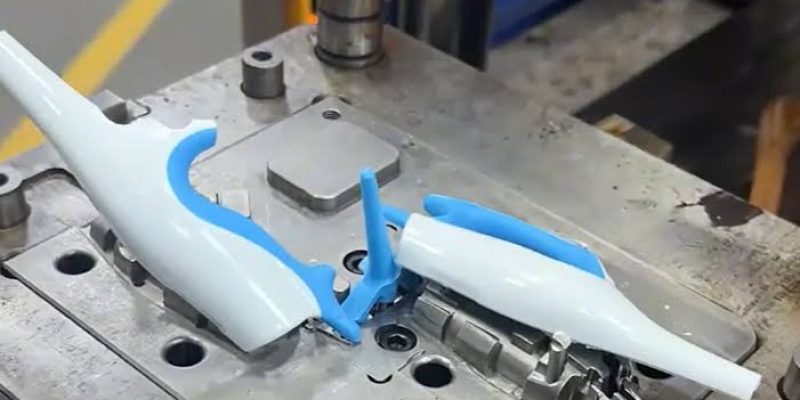
In an insert-overmolding process, for example, the first-shot substrate becomes the surface that the second material must bond to. If release agent is transferred onto that surface, the same substance that helped the first molding operation release from the mold can interfere with the second molding operation.
A TPE overmolding guide from the industry specifically warns against using mold release on inserts or in overmolding applications because it can significantly reduce the bond between the TPE and insert.
When the release agent is applied excessively
More release agent does not necessarily mean better molding.
Autodesk’s Moldflow troubleshooting documentation lists excessive use of mold release agent as one possible cause of delamination and recommends avoiding excessive release-agent use.
If a mold requires progressively more release agent to eject parts, the underlying problem may actually be related to draft, surface finish, geometry, ejection, or process conditions.
In that situation, increasing the amount of release agent can create a second problem: poor downstream adhesion.
When the substrate is molded first and overmolded later
A two-stage process creates more opportunity for surface contamination.
After the substrate is molded, it may be:
- handled manually,
- stored before the second operation,
- exposed to dust or oil,
- treated with release agent,
- or contaminated during transportation.
By the time the second material is injected, the substrate surface may no longer have the same condition it had when it left the first molding process.
This is particularly important for applications where the overmold depends heavily on direct material-to-material bonding.
Can Mold Release Cause Delamination Even When the Materials Are Compatible?
Yes.
Material compatibility is important, but compatible materials do not guarantee a strong bond under every molding condition.
A material supplier may identify a TPE grade as suitable for bonding to a particular substrate. That means the material combination has the potential to produce good adhesion. It does not mean that the bond will remain strong if the substrate surface is contaminated.
Think of it this way:
Material compatibility creates the opportunity for bonding. The molding process has to preserve that opportunity.
If a release agent sits between the substrate and overmold, the intended material-to-material interaction may be disrupted.
This is one reason it can be misleading to say:
“The TPE and substrate are compatible, so the material cannot be the problem.”
The problem may not be the material pair at all. It may be the condition of the interface.
How Can You Tell If Mold Release Is Actually the Cause?
This is the most important question to answer before changing materials.
A useful troubleshooting approach is to compare the failed parts with the molding history.
1. Check where the separation occurs
Look at the failure surface.
If the overmold separates cleanly from the substrate, the interface itself may be the weak point.
If the elastomer tears while remaining strongly attached to the substrate, the failure is different: the interface may actually be stronger than the elastomer.
Do not treat these two failure modes as the same problem.
2. Review how release agent is being used
Ask:
- Is an external mold release being sprayed?
- Where is it being applied?
- Is it being applied directly to the cavity?
- Could overspray reach the insert or substrate?
- How frequently is it being applied?
- Is the amount increasing over time?
Autodesk specifically recommends avoiding excessive mold-release use when troubleshooting delamination.
3. Compare parts produced with different release conditions
One of the most useful practical tests is to isolate the variable.
For example, where the mold and ejection system permit it, compare parts produced with:
normal release-agent use
versus
reduced or eliminated release-agent use
while keeping the other important process conditions as consistent as possible.
If adhesion changes significantly, release-agent involvement becomes much more likely.
This kind of controlled comparison is more useful than simply switching to another TPE and hoping the problem disappears.
4. Look for inconsistent adhesion
Release-agent contamination does not always produce a uniform failure.
If some regions bond well while other regions peel, investigate whether release agent or another contaminant could be reaching the interface unevenly.
An uneven failure pattern can also have other causes, such as flow behavior, substrate temperature, geometry, or local processing conditions, so it should be treated as a clue rather than proof.
What Else Can Cause Overmold Delamination?
Mold release is only one possibility.
Other common factors include:
Material incompatibility
The TPE may simply not be chemically or physically compatible with the selected substrate.
A different TPE grade can sometimes make a much larger difference than changing the molding parameters.
Poor substrate surface condition
Oil, dust, moisture, processing additives, or other contamination can interfere with adhesion.
Mold release agent is therefore part of a larger category:
surface contamination.
Incorrect processing conditions
Temperature has a major influence on overmold adhesion. The overmold needs to contact the substrate under conditions that allow the intended interfacial interaction to occur.
Teknor Apex identifies processing conditions as an important factor in TPE overmolding adhesion, in addition to material compatibility and contamination.
Insufficient mechanical retention
Some applications should not rely entirely on material-to-material adhesion.
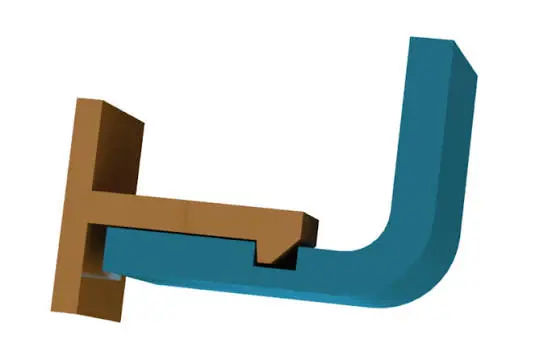
Undercuts, holes, grooves, ribs, or other geometric features can provide mechanical retention and reduce the consequences of a weak interface.
Shrinkage and thermal stress
Even when initial adhesion is acceptable, differences in material behavior during cooling or thermal cycling can create stress at the interface.
This is particularly important when a part passes an initial bonding test but later develops peeling or delamination during use.
Should You Stop Using Mold Release Agent?
Not necessarily.
The better question is:
Why does the mold need release agent in the first place?
If the mold can produce acceptable parts without external release agent, avoiding release-agent contamination of a bond-critical interface can simplify the process.
But if release agent is necessary for reliable ejection, eliminating it without addressing the underlying ejection problem may create a different production issue.
For example, excessive reliance on release agent may indicate that the mold needs attention to:
- draft angles,
- ejection design,
- surface finish,
- part geometry,
- undercuts,
- venting,
- or processing conditions.
For an overmolding project, the goal should not simply be “zero release agent.” The goal is a stable process that provides reliable ejection without compromising the bonding interface.
How to Prevent Release-Agent-Related Overmold Failure
The easiest time to address this issue is before tooling.
During material selection
Confirm that the selected overmold material is intended to bond to the actual substrate grade, not merely to a generic material family.
For example, “TPE for ABS” is less useful than knowing the exact TPE grade, exact ABS grade, and recommended processing conditions.
During DFM
Identify which surfaces are actually required to bond.
Then determine:
- Can those surfaces remain free of release-agent contamination?
- Is mechanical retention needed?
- Is the interface exposed to peel forces?
- Can the mold eject the part without relying heavily on release spray?
During molding trials
Monitor release-agent use as a process variable rather than treating it as an invisible part of molding.
Record:
- where it is applied,
- how often it is applied,
- how much is used,
- and whether adhesion changes when its use changes.
This makes it much easier to distinguish a material problem from a process problem.