
Understanding HDPE: Mechanical Properties, Advantages, and Limitations
Key Mechanical Properties of HDPE
HDPE exhibits a tensile strength ranging from 20 to 30 MPa with a yield stress typically around 26 MPa. Its semi-crystalline structure provides excellent impact resistance, maintaining toughness down to -40°C without becoming brittle.
The material demonstrates strong chemical resistance to most acids, bases, and polar solvents at room temperature. However, it swells or dissolves in non-polar solvents like hydrocarbons above 60°C. Low moisture absorption ensures high dimensional stability in humid environments.
Strategic Advantages of Using HDPE
HDPE offers a high strength-to-density ratio, making it ideal for lightweight structural components. Its recyclability code is #2, allowing for efficient reprocessing into new products with minimal energy loss compared to virgin production.
- Cost-Effectiveness: Lower raw material cost than engineering plastics like PEEK or PC.
- Fatigue Resistance: Withstands repeated bending cycles, perfect for living hinges.
From an engineering perspective, HDPE’s superior fatigue resistance allows for thin-walled hinge designs that survive over one million cycles. This reduces assembly costs by eliminating separate metal hinges or fasteners in container lids.
Potential Disadvantages and Design Constraints
HDPE has low stiffness, with a flexural modulus between 0.8 and 1.5 GPa, limiting its use in rigid load-bearing applications. Designers often add glass fibers or mineral fillers to increase rigidity, though this impacts recyclability.
The material is susceptible to environmental stress cracking when exposed to specific agents under tension. Additionally, its low surface energy makes painting or adhesive bonding difficult without plasma or flame treatment.
Heat deflection temperature is limited to approximately 80°C at 0.45 MPa load, restricting high-temperature applications. Engineers must account for creep deformation under sustained loads, especially at elevated temperatures near the melting point of 130°C.
Critical Design Guidelines and Processing Parameters for HDPE Injection Molding
Optimal Wall Thickness and Geometry
Maintain uniform wall thickness between 1.5 mm and 3.0 mm to prevent sink marks. Significant variations cause uneven cooling rates, leading to internal stresses and warpage.
- Rib Design: Keep rib thickness at 50-60% of the main wall thickness.
- Draft Angles: Apply a minimum draft of 1° per side for smooth ejection.
Use generous corner radii of at least 0.5 times the wall thickness. Sharp corners create stress concentration points that weaken the final part.
Shrinkage Rates and Dimensional Control
HDPE exhibits high shrinkage rates ranging from 1.5% to 3.0% due to its semi-crystalline nature. Flow direction significantly impacts dimensional stability, with higher shrinkage occurring perpendicular to the flow.
Compensate for shrinkage during CAD modeling by scaling dimensions up by the expected percentage. Allow parts to stabilize for 24-48 hours before final measurement to account for post-molding crystallization.
Essential Processing Parameters
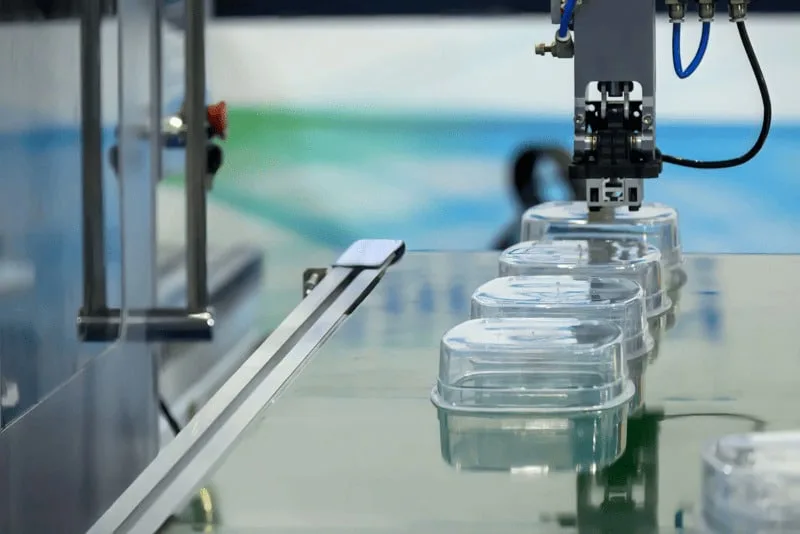
Set melt temperatures between 200°C and 230°C depending on the specific HDPE grade. Exceeding 250°C risks thermal degradation and loss of mechanical properties.
- Mold Temperature: Maintain between 20°C and 60°C.
- Effect: Lower temperatures reduce cycle time but may increase surface roughness.
Apply holding pressure at 50-80% of injection pressure to pack the mold effectively. Calculate cooling time using the formula $t_c \propto h^2$, where $h$ is the wall thickness.
Industrial and Consumer Applications of HDPE Injection Molding
Common Consumer Goods and Packaging
HDPE is ideal for bottle caps and closures due to its high fatigue resistance. This allows hinge mechanisms to withstand thousands of open-close cycles without failure.
- Household Durability: Buckets and crates benefit from HDPE’s impact strength at low temperatures.
- Food Safety: Manufacturers use FDA-compliant grades for kitchenware to prevent chemical leaching.
Personal care packaging leverages HDPE’s moisture barrier properties. This ensures product stability and extends shelf life for lotions and shampoos.
Industrial and Automotive Components
Chemical resistance makes HDPE the standard for fuel tanks and fluid reservoirs. It withstands exposure to gasoline, oils, and acidic fluids without degrading.
Automotive interior trim uses HDPE for its lightweight nature and ease of molding. Under-hood components require heat-stabilized grades to survive engine bay temperatures up to 100°C.
Specialized Use Cases
Medical devices often utilize medical-grade HDPE for its compatibility with gamma sterilization. The material maintains structural integrity after repeated sterilization cycles.
Outdoor applications demand UV-stabilized compounds with carbon black additives. This prevents polymer chain breakdown from solar radiation over years of exposure.
- Electrical Insulation: HDPE offers high dielectric strength for cable jacketing.
- Marine Use: Its low water absorption prevents swelling in boat components.
Comparative Analysis: HDPE vs. Polypropylene (PP) and Nylon
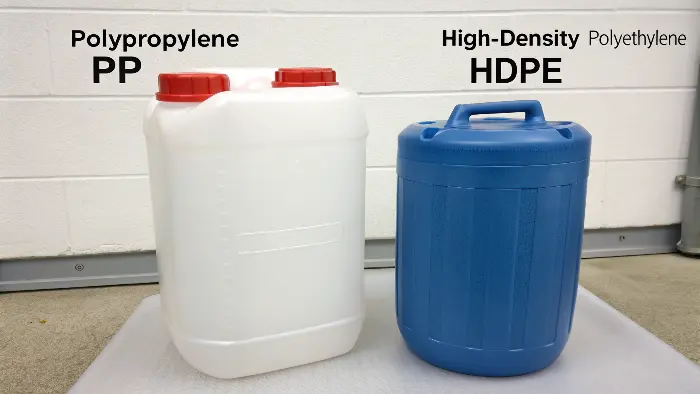
HDPE vs. Polypropylene (PP)
Processing temperatures differ significantly between these two polyolefins. PP requires higher melt temperatures, typically ranging from 200°C to 280°C, while HDPE processes comfortably between 180°C and 250°C.
PP offers superior stiffness and a higher flexural modulus compared to HDPE. This makes PP ideal for rigid containers that must maintain shape under load.
HDPE is generally cheaper per kilogram and flows easier in molds. However, PP dominates applications requiring living hinges due to its exceptional fatigue resistance.
HDPE vs. Nylon (Polyamide)
Nylon provides far greater mechanical strength and wear resistance than HDPE. It is the preferred choice for gears and bearings where friction and load are critical factors.
Moisture absorption severely impacts Nylon’s dimensional stability. Parts may swell or warp in humid environments, whereas HDPE remains dimensionally stable.
HDPE exhibits excellent chemical resistance to acids and bases. Nylon degrades in strong acidic environments but handles oils and fuels better than HDPE.
Decision Framework for Material Selection
Choose HDPE when budget constraints are tight and chemical exposure is high. It is the standard for chemical tanks, pipes, and low-cost consumer packaging.
Switch to PP if your application involves steam sterilization or higher operating temperatures. PP maintains integrity up to 100°C, outperforming HDPE’s 80°C limit.
Select Nylon for high-load structural components requiring precision. The higher material cost is justified by its superior tensile strength and wear life.
Balance performance needs against total part cost. Use HDPE for non-critical parts, PP for semi-structural needs, and Nylon only when mechanical demands exceed polyolefin capabilities.
Finding the Right HDPE Injection Molding Manufacturing Partner
Evaluating Manufacturer Capabilities
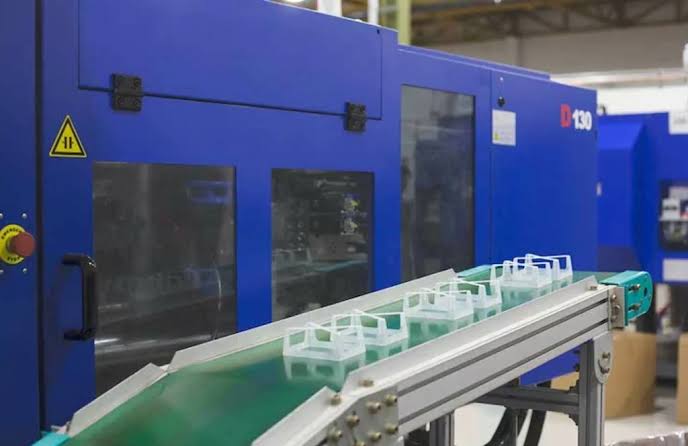
HDPE is a semi-crystalline material with high shrinkage rates, typically ranging from 1.5% to 3.0%. Partners must demonstrate specific expertise in managing this shrinkage to prevent dimensional instability.
- Machine Requirements: Look for machines with robust clamp forces to handle HDPE’s viscosity.
- Certifications: Verify ISO 9001 for general quality and IATF 16949 for automotive-grade consistency.
Ensure the supplier can seamlessly transition from low-volume prototyping to mass production. This flexibility prevents costly re-tooling when scaling up output.
Importance of Design for Manufacturing (DFM) Support
Early DFM feedback identifies risks like sink marks or warpage before steel is cut. Simulation tools predict flow patterns and cooling efficiency to optimize part geometry.
Collaborate on ejector pin placement to avoid marking visible surfaces. Proper design optimization directly reduces tooling complexity and overall manufacturing costs.
Questions to Ask Potential Service Providers
Clarify lead times for both mold fabrication and first article inspections. Typical mold builds take 4–8 weeks, depending on complexity and cavity count.
- Material Sourcing: Ask if they recommend specific HDPE grades for impact resistance or chemical stability.
- Post-Processing: Confirm capabilities for ultrasonic welding, pad printing, or custom packaging.
Request case studies demonstrating successful HDPE projects similar to your application. References validate their ability to handle material-specific challenges like stress cracking.