
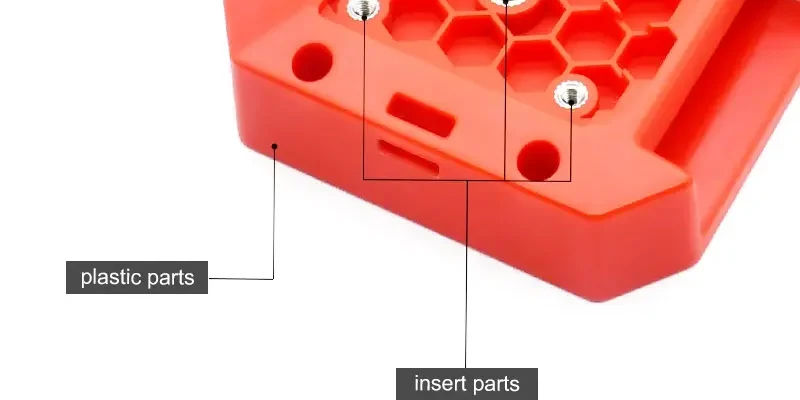
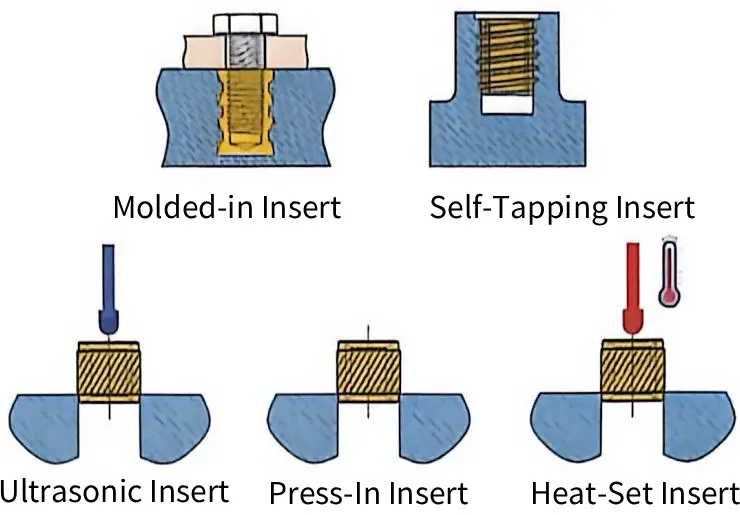
If a part needs to be assembled and disassembled many times, I recommend using metal threaded inserts. Most inserts should be installed by ultrasonic or heat insertion to reduce residual stress. Common insert types are shown in Figure below. In this section, we focus on molded-in inserts and press-in inserts.
Molded-In Inserts
With molded-in inserts, we place the insert into the mold before injection molding. This method provides the highest resistance to pull-out and torque.
However, as the plastic cools and shrinks around the insert, high residual stress can develop. We generally do not recommend molded-in inserts for amorphous plastics such as PC and ABS, because the stress may cause crazing, cracking, or part failure. Glass fiber reinforced plastics have a thermal expansion rate closer to metal, so these problems are less common. Molded-in inserts are also widely used with thermoset plastics and rubber because these materials generate lower stress.
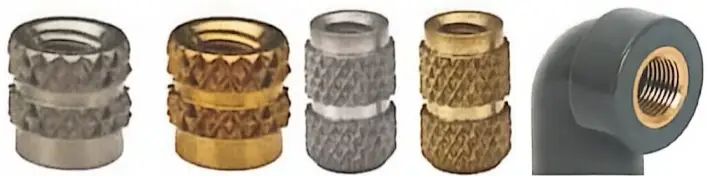
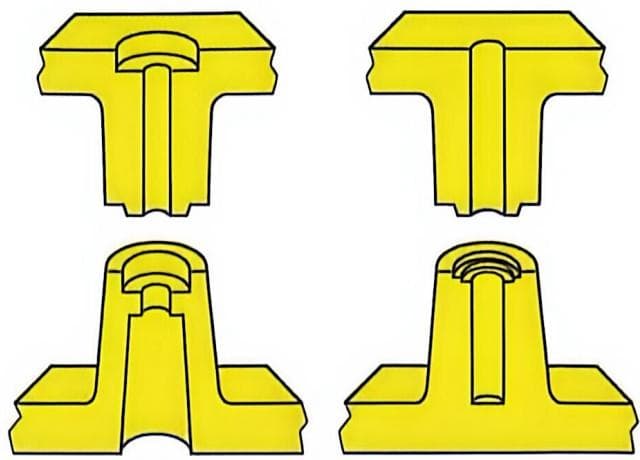
We can use smooth inserts or inserts with knurls and grooves. Inserts may have either blind holes or through holes. For some plastics, we prefer blind-hole inserts because they prevent plastic from entering the threads. Blind holes should ideally have a rounded bottom and a rounded head.
Before placing inserts into the mold, we always clean them to remove oil, grease, and other contaminants. We also make sure each insert is securely positioned so it does not move or damage the mold.
We avoid inserts with very sharp knurls or teeth. Although they improve pull-out strength, they also create stress concentrations that may lead to early failure.
If the insert diameter is larger than 6.5 mm, thermal stress can become excessive. We recommend preheating the insert to a temperature close to the mold temperature before molding.
Table below provides recommended boss diameters and wall thicknesses for common round metal inserts used in thermoplastics.
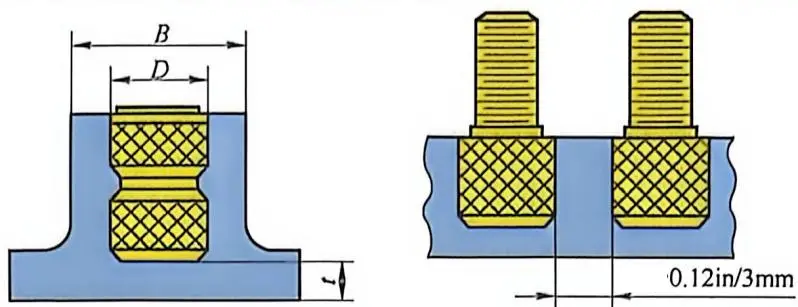
| Diameter external/D | Diameter B/in Reinforced plastic | Thickness t/in Reinforced plastic | Diameter B/in Unreinforced plastic | Thickness t/in Unreinforced plastic |
| 0.156 | 0.312 | 0.062 | 0.312 | 0.062 |
| 0.187 | 0.344 | 0.062 | 0.360 | 0.062 |
| 0.218 | 0.406 | 0.078 | 0.422 | 0.078 |
| 0.25 | 0.453 | 0.078 | 0.500 | 0.078 |
| 0.281 | 0.484 | 0.093 | 0.531 | 0.093 |
| 0.343 | 0.578 | 0.093 | 0.609 | 0.109 |
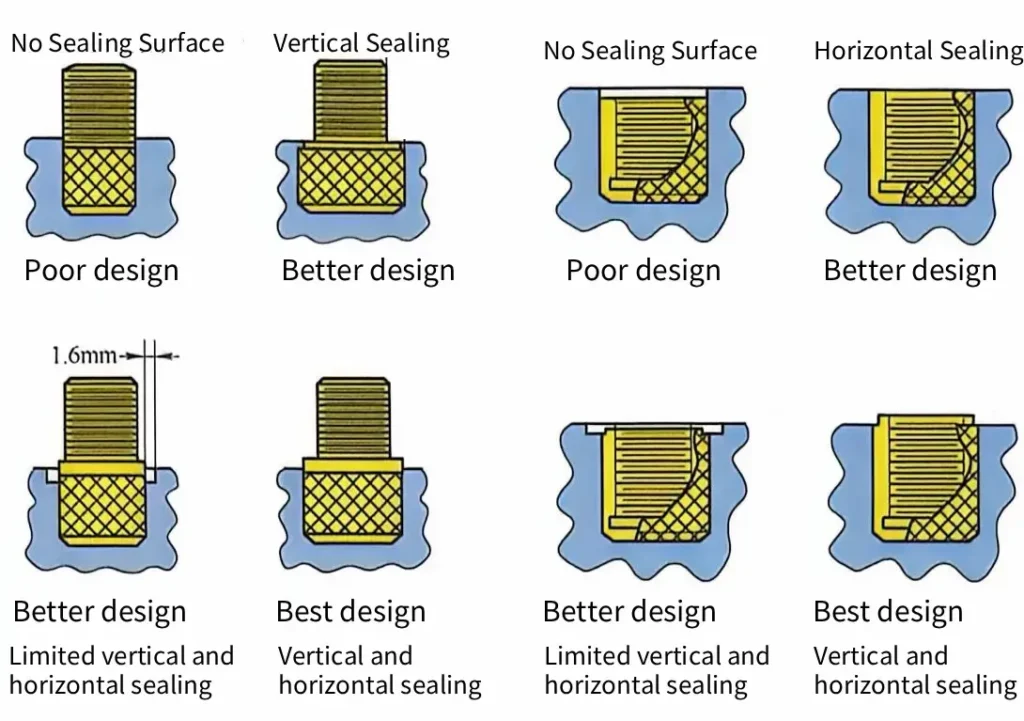
For molded-in threaded inserts that extend above the plastic surface, we recommend adding both sealing . This prevents plastic flash from entering the threads during molding.
Press-In Inserts
We usually install press-in inserts after injection molding to create internal threads in plastic parts. Compared with other insert types, they are generally more economical because of their simple design and installation process. However, their pull-out and torque performance is usually lower.
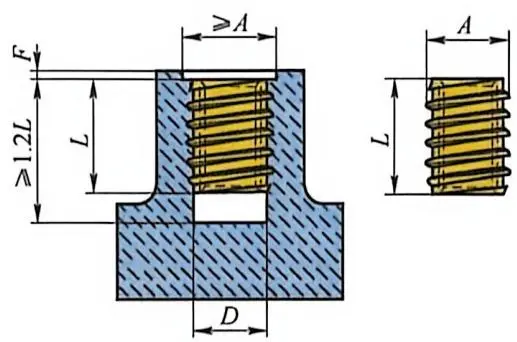
We recommend designing the insert hole deeper than the insert length.
- For self-tapping inserts, we recommend a minimum hole depth of 1.2 × the insert length.
- For other insert types, we recommend a minimum hole depth equal to the insert length plus two thread pitches.
We also recommend making sure the assembly screw never bottoms out in the hole, as this may push the insert out of the plastic.
As shown in picture below, we recommend positioning the top of the insert as close as possible to the supporting surface. If the insert sits too far below the surface, it is more likely to be pushed out during assembly.
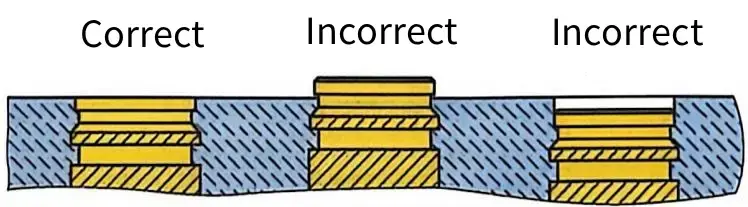
Correct hole size is critical. We know that a hole that is too large reduces insert performance, while a hole that is too small creates excessive stress and may cause cracks.
Whenever possible, we recommend using molded holes instead of drilled holes. Molded holes have stronger and denser surfaces, which improve insert performance.
As shown in picture below:
- We recommend a draft angle of no more than 1° for straight holes.
- We recommend an 8° taper for tapered holes.
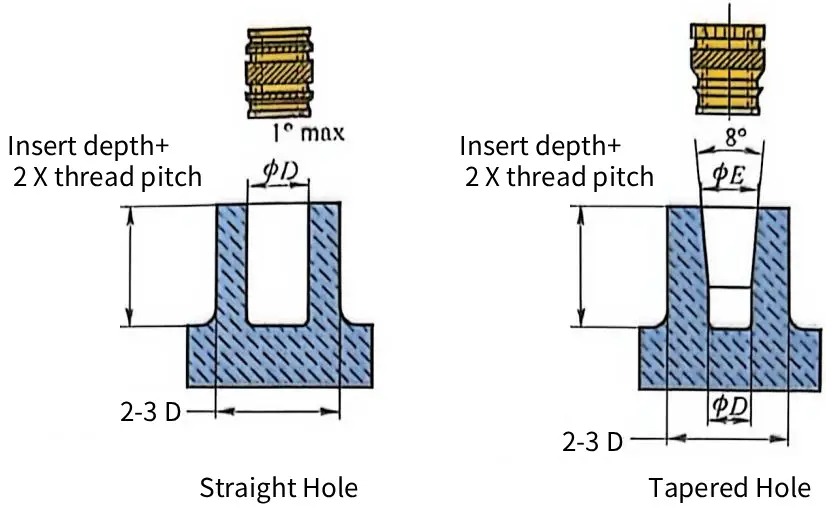
Tapered holes make installation easier and improve insert alignment. We only use tapered inserts with tapered holes.