Sourcing and Specifications for Industrial Cast Acrylic Sheets
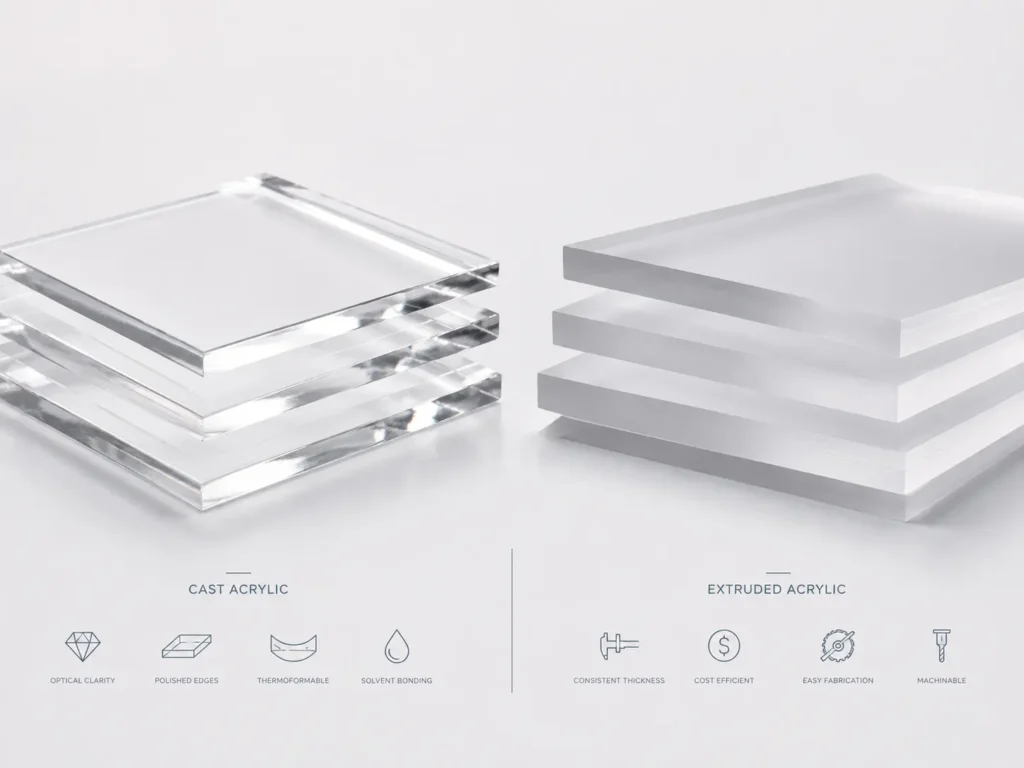
Understanding Cast vs. Extruded Acrylic for Fabrication
Cast acrylic features long polymer chains that provide superior molecular stability. This structure prevents cracking during aggressive CNC machining or drilling operations.
Extruded acrylic has shorter chains and lower viscosity thresholds. It tends to melt or gum up cutting tools rather than chip cleanly.
| Property | Cast Acrylic | Extruded Acrylic |
|---|---|---|
| Machining Quality | Clean chips, smooth edges | Gummy residue, rough edges |
| Thermoforming | Uniform heating, low stress | Prone to warping, high stress |
| Chemical Resistance | High resistance to solvents | Lower resistance, may craze |
Cast acrylic maintains structural integrity under thermal stress. It is the preferred choice for complex thermoforming applications requiring precise dimensions.
Selecting the Right Dimensions and Thickness
Standard industrial panels typically measure 4×8 feet (72×96 inches). This size balances material yield with manageable logistics for most fabrication shops.
Thicker sheets require strict tolerance controls to ensure flatness. A 0.5-inch (12mm) sheet usually holds a thickness tolerance of ±0.030 inches.
- Weight Calculation: A 4×8 foot sheet of 0.5-inch acrylic weighs approximately 130 lbs (59 kg).
- Handling Requirement: Two-person lift or vacuum suction cups are mandatory for safe movement.
- Support Structure: Use flat, rigid supports to prevent sagging during storage.
Improper handling of heavy sheets leads to surface scratches and micro-cracks. Always verify weight limits for your shop’s lifting equipment before ordering.
Quality Control and Optical Clarity Standards
High-grade cell-cast acrylic must exhibit minimal internal stress. Stress points appear as rainbow patterns when viewed through polarized lenses.
Inspect every sheet for bubbles, inclusions, or surface pits before acceptance. Even small defects can propagate into cracks during machining or bending.
| Inspection Point | Acceptance Criteria | Rejection Reason |
|---|---|---|
| Surface Clarity | No visible scratches or haze | Light scattering defects |
| Internal Structure | Free of bubbles >0.5mm | Structural weakness |
| Edge Quality | Clean, chip-free cut lines | Stress initiation points |
Request ASTM D4802 compliance data from your supplier. This standard ensures consistent quality for transparent plastic sheets.
Verify the material batch number against the provided Certificate of Analysis. Consistent sourcing prevents variability in fabrication outcomes.
Optical Transparency and Light Transmission Properties
Comparing Acrylic Transparency to Glass
Acrylic sheets typically achieve a light transmission rate of 92%. This exceeds standard glass, which usually ranges between 80% and 90%.
The refractive index of acrylic is approximately 1.49. This value is close to that of glass, minimizing visual distortion in most applications.
- UV Stability: Standard acrylic resists yellowing for up to 10 years outdoors.
- Degradation Risk: Untreated polycarbonate may yellow within 2–3 years under direct sunlight.
Measuring Haze and Clarity in Transparent Plastics
ASTM D1003 is the industry standard for measuring haze and luminous transmittance. It quantifies the percentage of light scattered rather than transmitted directly.
Surface polish significantly affects perceived clarity. Rough edges or poor machining can scatter light, increasing haze values by 5–10%.
| Thickness (mm) | Light Absorption Impact | Color Fidelity Shift |
|---|---|---|
| 1–3 mm | Negligible | None |
| 10–20 mm | Moderate | Slight green/blue tint |
| >50 mm | High | Noticeable distortion |
Thicker materials absorb more light. This absorption can alter color fidelity, especially in clear grades with slight inherent tints.
Applications Requiring High Optical Precision
Museum display cases and optical lenses demand high precision. Acrylic is preferred for its lightweight nature and shatter resistance compared to glass.
Scratch-resistant coatings are essential for maintaining clarity. Uncoated acrylic has a pencil hardness of roughly B, making it prone to micro-scratches.
- Anti-Reflective (AR) Treatments: Reduce surface reflection from 4% to less than 1%.
- Visibility Enhancement: AR coatings improve contrast in bright lighting conditions.
These treatments extend the functional life of the material. They ensure consistent optical performance in high-traffic environments.
Affordable Translucent Acrylic Options for DIY and Crafts
Choosing Between Translucent White and Clear Acrylic
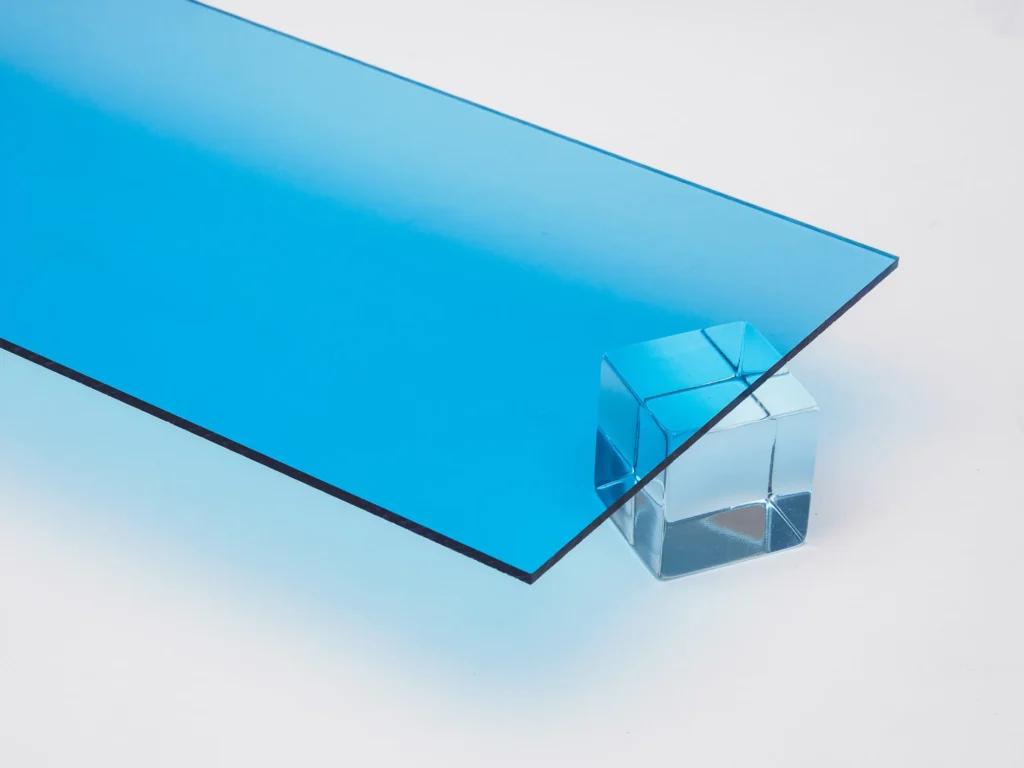
Translucent white acrylic diffuses light rather than transmitting it directly. This creates a soft, even glow ideal for lampshades or signage.
Clear acrylic offers high transparency but highlights surface imperfections and scratches. Translucent variants mask minor flaws, reducing the need for perfect finishing.
| Property | Clear Acrylic | Translucent White Acrylic |
|---|---|---|
| Light Transmission | ~92% (Direct) | ~50-70% (Diffused) |
| Surface Visibility | High (Shows defects) | Low (Hides defects) |
| Best Use Case | Windows, Displays | Lighting, Privacy Panels |
Translucent sheets often cost less due to lower optical grade requirements. They are a practical choice for non-critical visual applications.
Sourcing Small-Sheet and Cut-to-Size Acrylic
Local plastic distributors frequently sell off-cuts at significant discounts. These remnants are perfect for small crafts where full-sheet pricing is prohibitive.
Online marketplaces offer convenience but may charge high shipping fees for heavy items. Compare local pickup options against online bulk rates to maximize savings.
- Check Local Suppliers: Ask for “drop pieces” or scrap bins.
- Verify Dimensions: Ensure thickness tolerance is within ±0.4mm for your project.
- Batch Consistency: Buy from the same lot to avoid color variation in translucent whites.
Buying standard sizes like 12×12 inches or 24×24 inches reduces waste. Custom cutting services often add a 15-20% premium to the base material cost.
Working with Thin-Gauge Acrylic for Crafts
Thin-gauge acrylic (1mm–3mm) cuts easily with a scoring tool. Score deeply along a straight edge and snap cleanly to avoid chipping.
Laser cutters provide precise edges but require proper ventilation. Set power levels low to prevent melting or excessive flame polishing on thin sheets.
- Scoring: Use a carbide-tipped scorer for clean breaks.
- Sawing: Use a fine-tooth jigsaw blade (10+ TPI) to reduce cracking.
- Speed: Feed material slowly to prevent heat buildup.
Bonding translucent acrylic requires solvents that do not cloud the material. Weld-on #3 or #4 adhesives work well for capillary action bonding.
Sand edges with wet sandpaper starting at 400 grit. Progress to 800 or 1000 grit for a smooth, frost-free finish. Avoid dry sanding to prevent heat-induced micro-cracks.
Vacuum Coating Techniques for Plastic Optical Components
Challenges of Coating Transparent Plastics
Plastic substrates have significantly lower thermal tolerance than glass. Most engineering plastics soften between 80°C and 150°C.
- Thermal Limits: Exceeding the glass transition temperature ($T_g$) causes permanent warping.
- Heat Management: Coating processes must keep substrate temperatures below 60°C to ensure dimensional stability.
Adhesion fails frequently due to the chemical inertness of polymers like PMMA or Polycarbonate. These materials possess low surface energy, often below 40 dynes/cm.
| Material | Typical Surface Energy (dynes/cm) | Adhesion Risk |
|---|---|---|
| Glass | >70 | Low |
| Polycarbonate | ~40-45 | High |
| PMMA (Acrylic) | ~35-40 | Very High |
Vacuum environments create pressure differentials that stress thin plastic parts. Internal stresses from molding can release under heat, leading to substrate deformation.
- Constraint: Fixturing must support the part without inducing mechanical stress points.
- Risk: Uneven heating causes localized shrinkage, distorting optical paths.
Pre-Treatment Methods for Enhanced Adhesion
Plasma cleaning effectively activates polymer surfaces by breaking molecular bonds. This process increases surface energy to over 60 dynes/cm within minutes.
- Mechanism: Ion bombardment removes organic contaminants and creates polar functional groups.
- Parameter: Typical exposure times range from 30 to 120 seconds at low power (50-100 W).
Primers act as a chemical bridge between the plastic and the metallic or oxide coating. Silane-based primers are common for improving bond strength on inert surfaces.
- Apply a thin primer layer (0.1–0.5 µm) via spin coating or dipping.
- Cure the primer at low temperatures.
Common Vacuum Coating Materials and Processes
Anti-reflective (AR) and mirror coatings serve distinct optical functions on plastic lenses. AR coatings typically use alternating layers of $SiO_2$ and $TiO_2$.
| Coating Type | Primary Material | Target Reflection |
|---|---|---|
| Anti-Reflective | $SiO_2$ / $TiO_2$ | 95% reflection |
| Conductive | ITO (Indium Tin Oxide) | 200°C, which melts or deforms standard optical plastics. |
Maintaining optical clarity requires precise control over layer thickness and uniformity. Deviations greater than ±2% in layer thickness cause color shifts in AR coatings.
- Monitoring: Use optical monitoring systems during deposition for real-time thickness control.
- Quality Check: Final haze values must remain below 1% to meet automotive and consumer electronics standards.
Advanced Nanoscale Photonic Structuring in Transparent Plastics
Femtosecond Laser Direct Writing Technology
Femtosecond lasers utilize nonlinear absorption to modify transparent materials. This process occurs only at the focal point where photon density is highest.
- Peak Intensity: Exceeds $10^{13} \text{ W/cm}^2$ to trigger multiphoton absorption.
- Pulse Duration: Typically ranges from 100 fs to 500 fs.
Ultra-short pulses prevent heat diffusion into surrounding areas. This minimizes thermal damage and preserves material integrity.
| Parameter | Typical Value | Impact |
|---|---|---|
| Pulse Width | $1\text{ TB/cm}^3$ (theoretical) |
Hybrid devices combine plastic flexibility with glass stability. Future trends focus on bonding these materials for enhanced durability.